Showing posts with label Erma Bombeck. Show all posts

Sunday, July 5, 2009

Independence Day (Ferron)


From yesterday's Writer's Almanac:

Today is Independence Day. On this day in 1776, the Second Continental Congress unanimously adopted the Declaration of Independence, and the United States officially broke from the rule of England. The colonists were trying to persuade other nations of Europe to be on their side, so they included a long list of complaints about the king. The document said of the king, in part, "He is, at this Time, transporting large Armies of foreign Mercenaries to complete the Works of Death, Desolation, and Tyranny, already begun with Circumstances of Cruelty and Perfidy, scarcely paralleled in the most barbarous Ages, and totally unworthy the Head of a civilized Nation."

Twenty-four years later, in 1804, the explorers Lewis and Clark had the first Fourth of July celebration west of the Mississippi. They were traveling through a part of the Midwest that is now Kansas. They stopped at the mouth of a creek on July 4th, and named it Independence Creek in honor of the day. To celebrate, they fired their cannon at sunset and distributed an extra ration of whisky to the men.

There were unofficial celebrations of Independence Day from its first anniversary, but it really became a popular holiday after the War of 1812. On the frontier, it was the only time of the year when everyone in the countryside gathered together in one place. There would be parades and speeches, and the prettiest and most wholesome girl in the village would be named the Goddess of Liberty. Politicians would get up and call the king of England a skunk and challenge him to a fight. Drunk men in the streets would get into fights and call each other Englishmen. Soon, events like groundbreaking ceremonies for the Erie Canal and the Baltimore and Ohio Railroads were scheduled to coincide with July 4th festivities.

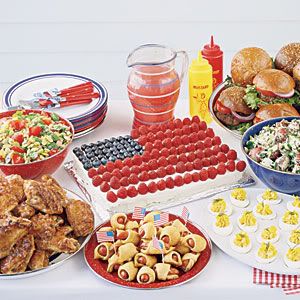
We're actually honoring the Fourth of July today rather than yesterday (although last night we did watch the PBS concert/fireworks on TV) - we bought an inexpensive grill at Home Depot and will cook out hot dogs and hamburgers, and round out the meal with corn on the cob, potato salad, fresh fruit and a patriotically-decorated chocolate cake. There will be 10 of us (immediate family, significant others and a few friends) - we'll also celebrate two (July 2) birthdays: my husband's and my brother's girlfriend's.

After clean-up time, my husband and I will head back over to my sister's to spend one last night together before he flies back to Florida Monday evening - it's going to be so hard to say goodbye (don't go there yet, Susan!)...


Although I watched and waited for it every day,
somehow I missed it, the moment when everything reached
the peak of ripeness. It wasn't at the solstice; that was only
the time of the longest light. It was sometime after that, when
the plants had absorbed all that sun, had taken it into themselves
for food and swelled to the height of fullness. It was in July,
in a dizzy blaze of heat and fog, when on some nights
it was too hot to sleep, and the restaurants set half their tables
on the sidewalks; outside the city, down the coast,
the Milky Way floated overhead, and shooting stars
fell from the sky over the ocean. One day the garden
was almost overwhelmed with fruition:
My sweet peas struggled out of the raised bed onto the mulch
of laurel leaves and bark and pods, their brilliantly colored
sunbonnets of rose and stippled pink, magenta and deep purple
pouring out a perfume that was almost oriental. Black-eyed Susans
stared from the flower borders, the orange cherry tomatoes
were sweet as candy, the fruit fattened in its swaths of silk,
hummingbirds spiraled by in pairs, the bees gave up
and decided to live in the lavender. At the market,
surrounded by black plums and rosy plums and sugar prunes
and white-fleshed peaches and nectarines, perfumey melons
and mangos, purple figs in green plastic baskets,
clusters of tiny Champagne grapes and piles of red-black cherries
and apricots freckled and streaked with rose, I felt tears
come into my eyes, absurdly, because I knew
that summer had peaked and was already passing
away. I felt very close then to understanding the mystery;
it seemed to me that I almost knew
what it meant to be alive, as if my life had swelled
to some high moment of response, as if I could
reach out and touch the season, as if I were inside
its body, surrounded by sweet pulp and juice,
shimmering veins and ripened skin.

QUOTE: "You have to love a nation that celebrates its independence... with family picnics where kids throw Frisbees, the potato salad gets iffy, and the flies die from happiness." ~ Erma Bombeck

Sunday, May 11, 2008

Mothers, Daughters, Wives (Judy Small)

For my mom, my stepmother-in-law and for all the mothers out there, most of whom continue to believe that peace is achievable - "study war no more" indeed...

From UncommonGoods.com:

Who are the mothers of Mother's Day? Before President Woodrow Wilson made it an official holiday in 1915, Mother's Day wasn't about flowers and cards, but instead it was a tribute to women's peace-making activities.

Mother's Day is actually a marriage of two separate campaigns that began during the Civil War. The first version of Mother's Day is attributed to Anna M. Jarvis of West Virginia who participated in Mother's Work Days, in which women's brigades worked to improve critical community sanitation. In 1868, Jarvis established Mother's Friendship Day, which encouraged women to ease tensions between North and South once the war was over.

The second mother of Mother's Day was Bostonian Julia Ward Howe, author of "The Battle Hymn of the Republic," who called upon all women to band together to abolish war. Her Mothers' Peace Day celebrations took place for several years in Boston and other cities until the end of World War I.

[Added 5/12/08: For These Stars, Mom Rules by Donna St. George, Washington Post Staff Writer - thanks, AW, for the heads-up on the MCC list! ]


POEM: Prayer Chain by Tim Nolan

My mother called to tell me
about an old classmate of mine who

was dying on the parish prayer chain—
or was very sick—or destitute—

or it had not worked out—the marriage—
or the kids were all on drugs—and

all the old mothers were praying intensely
for all the pain of their children

and for life—they were praying for life—
in their quiet rooms—sipping decaf coffee—

I bet they've been praying for me at times—
so I'll find my way—so I won't rob a bank—

I'll take them—the mystical prayers of old mothers—
it matters—all this patient and purposeful love.

QUOTE: "Mothers are not the nameless, faceless stereotypes who appear once a year on a greeting card with their virtues set to prose, but women who have been dealt a hand for life and play each card one at a time the best way they know how. No mother is all good or all bad, all laughing or all serious, all loving or all angry. Ambivalence rushes through their veins." ~ Erma Bombeck

Tuesday, November 20, 2007

Uncle Dave's Grace (Lou and Peter Berryman)

A bit of levity for the upcoming holiday... :-)


POEM: A Turkey Speaks ~ Author Unknown

I have never understood
why anyone would
roast the turkey
and shuck the clams
and crisp the croutons
and shell the peas
and candy the sweets
and compote the cranberries
and bake the pies
and clear the table
and wash the dishes
and fall into bed
when they could sit back
and enjoy a hamburger.

QUOTE(S): "Thanksgiving dinners take eighteen hours to prepare. They are consumed in twelve minutes. Half-times take twelve minutes. This is not coincidence." ~ Erma Bombeck

"Coexistence: what the farmer does with the turkey - until Thanksgiving." ~ Mike Connolly

Tuesday, July 10, 2007

Break the Cup (Buddy Mondlock)

My favorite chapter from the book below seems to sum up my attitude after this last week of struggle:

"See the Glass as Already Broken (and Everything Else Too)

This is a Buddhist teaching that I learned over twenty years ago. It has provided me, again and again, with greatly -needed perspective to guide me toward my goal of a more accepting self.

The essence of this teaching is that all of life is in a constant state of change. Everything has a beginning and everything has an end. Every tree begins with a seed and will eventually transform back into earth. Every rock is formed and every rock will vanish. In our modern world, this means that every car, every machine, every piece of clothing is created and all will wear out and crumble; it's only a matter of when. Our bodies are born and they will die. A glass is created and will eventually break.

There is peace to be found in this teaching. When you expect something to break, you're not surprised or disappointed when it does. Instead of becoming immobilized when something is destroyed, you feel grateful for the time you have had.

The easiest place to start is with the simple things, a glass of water, for example. Pull out your favorite drinking glass. Take a moment to look at and appreciate its beauty and all it does for you. Now, imagine that same glass as already broken, shattered all over the floor. Try to maintain the perspective that, in time, everything disintegrates and returns to its initial form.

Obviously, no one wants their favorite drinking glass, or anything else, to be broken. This philosophy is not a prescription for becoming passive or apathetic, but for making peace with the way things are. When your drinking glass does break, this philosophy allows you to maintain your perspective. Rather than thinking, "oh my god", you'll find yourself thinking, "ah, there it goes". Play with this awareness and you'll find yourself not only keeping your cool but appreciating life as never before."

P.S. I've googled myself silly and can't seem to find Buddy Mondlock's lyrics anywhere - do yourself a favor and go to his website to familiarize yourself with an extraordinary songwriter (soft voice, huge heart... :-)

SONG: Break the Cup by Buddy Mondlock


POEM: Advice to Myself by Louise Erdich

Leave the dishes.
Let the celery rot in the bottom drawer of the refrigerator
and an earthen scum harden on the kitchen floor.
Leave the black crumbs in the bottom of the toaster.
Throw the cracked bowl out and don't patch the cup.
Don't patch anything. Don't mend. Buy safety pins.
Don't even sew on a button.
Let the wind have its way, then the earth
that invades as dust and then the dead
foaming up in gray rolls underneath the couch.
Talk to them. Tell them they are welcome.
Don't keep all the pieces of the puzzles
or the doll's tiny shoes in pairs, don't worry
who uses whose toothbrush or if anything
matches, at all.
Except one word to another. Or a thought.
Pursue the authentic - decide first
what is authentic,
then go after it with all your heart.
Your heart, that place
you don't even think of cleaning out.
That closet stuffed with savage mementos.
Don't sort the paper clips from screws from saved baby teeth
or worry if we're all eating cereal for dinner
again. Don't answer the telephone, ever,
or weep over anything at all that breaks.
Pink molds will grow within those sealed cartons
in the refrigerator. Accept new forms of life
and talk to the dead
who drift in though the screened windows, who collect
patiently on the tops of food jars and books.
Recycle the mail, don't read it, don't read anything
except what destroys
the insulation between yourself and your experience
or what pulls down or what strikes at or what shatters
this ruse you call necessity.

QUOTE: "My theory on housework is, if the item doesn't multiply, smell, catch fire, or block the refrigerator door, let it be. No one else cares. Why should you?" ~ Erma Bombeck